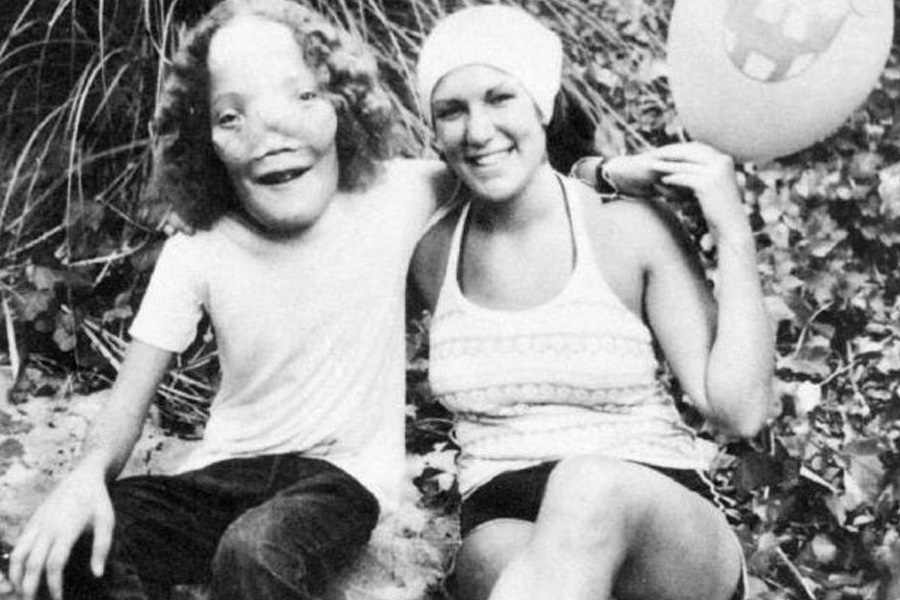
Who Was Roy L. Dennis
Roy Lee Dennis, widely known as Rocky Dennis, was born on December 4, 1961, in Glendora, California. He became known for living with craniodiaphyseal dysplasia, an exceptionally rare disorder that causes excessive growth and hardening of bone, particularly in the skull and facial bones.
When I look at Rocky’s story, the medical diagnosis is only one part of it. His illness shaped nearly every stage of his childhood, but it did not completely define the person he became. He was a student, artist, son, brother, friend, and teenager who wanted to participate in ordinary life rather than be treated as a medical curiosity.
Rocky received his diagnosis when he was about 2 years old. During a tonsillectomy, doctors noticed abnormalities in his skull on X-rays. Further examinations at UCLA Medical Center identified the unusual bone disorder. Physicians reportedly believed that the disease would progress rapidly and predicted that he might not survive beyond early childhood.
Instead, Rocky lived until October 4, 1978. He was 16 years old.
His life later inspired the 1985 film Mask, with Eric Stoltz portraying Rocky and Cher portraying his mother, Florence “Rusty” Tullis.
Living With Craniodiaphyseal Dysplasia
Craniodiaphyseal dysplasia, sometimes called lionitis or leontiasis ossea in descriptions of severe facial involvement, is an extremely rare skeletal disorder. It causes abnormal bone formation and progressive thickening, particularly around the skull.
The skull contains numerous openings through which nerves, blood vessels, and other structures pass. As abnormal bone accumulates, those openings can become increasingly narrow. For someone with severe CDD, the consequences can extend far beyond appearance.
Rocky experienced progressive changes to his face, problems with vision, headaches, and other complications associated with the disease. He was considered legally blind at approximately 6 years old, with reported vision in the range of 20/200 to 20/300. Yet blindness did not become his identity.
He learned to read and continued participating in school. His response to his deteriorating eyesight reflected his determination to remain active rather than surrender to the expectations surrounding his diagnosis.
The disease can also affect hearing, the nasal passages, teeth, and the cranial nerves. In severe cases, increasing bone growth can contribute to elevated intracranial pressure and neurological complications. Treatment remains difficult because the abnormal bone is dense, extensive, and often located around delicate structures.
| Detail | Information |
|---|---|
| Full name | Roy Lee Dennis |
| Nickname | Rocky |
| Born | December 4, 1961 |
| Birthplace | Glendora, California |
| Condition | Craniodiaphyseal dysplasia |
| Legally blind | Around age 6 |
| Age at death | 16 |
| Died | October 4, 1978 |
| Place of death | Covina, California |
| Film inspired by his life | Mask |
Why He Was Called Rocky
The nickname Rocky reportedly began when Roy was a baby. He would prop himself up on his knees and rock his cradle.
The name stayed with him throughout his childhood. In a life filled with hospital examinations, medical predictions, and physical challenges, “Rocky” became an especially fitting nickname. It suggested movement and persistence rather than fragility.
That persistence became one of the defining characteristics of his childhood.
Doctors had warned that his condition could lead to severe disability and an early death. His mother, however, resisted allowing those predictions to dictate how he was raised. She wanted Rocky to experience school, friendships, independence, humor, and the ordinary frustrations of growing up.
Rocky Dennis and His Mother Rusty Tullis
One of the most important individuals in Rocky’s life was Florence “Rusty” Tullis. Born in Brooklyn, New York, on May 29, 1936, Florence Steinberg later relocated to California and wed Roy Dennis in 1959.
Rusty had an unusual upbringing. She dropped out of school at an early age, worked in entertainment and customer service, rode motorcycles, and experienced a variety of settings. She also experienced drug use at some points in her life and later ran into legal issues.
Rusty took on the role of Rocky’s primary parent following her divorce from Roy Dennis in 1971.
Her treatment of his sickness was unconventional and occasionally contentious. She stressed independence and normalcy instead of pushing him to believe that he was always ill. She apparently promoted a philosophy based on the notion that the mind could affect the physical and taught him breathing exercises and biofeedback procedures.
Her reluctance to allow other people’s expectations become Rocky’s boundaries was one of her most enduring traits.
Rusty’s life was tough, and their connection wasn’t flawless. However, Rocky’s plot revolved around the relationship between mother and son. When she thought he was being unjustly excluded, she confronted school administrators and urged him to take part in regular activities.
Later, Cher played Rusty in Mask, which made the family’s tale much more widely known.
Roy Dennis and the Family Home
Roy Dennis, Rocky’s legal father, was a painting contractor and house painter. He married Rusty in 1959, and the couple moved to the Covina area.
Rusty and Roy eventually divorced, but Roy remained involved with Rocky. Accounts describe him as an important figure in Rocky’s life even after the marriage ended.
For periods when Rusty was away, Rocky’s care involved Roy, relatives, and other members of the extended household. The family environment could be unconventional and sometimes turbulent, but Rocky was surrounded by adults and community members who contributed to his upbringing.
His story therefore cannot be understood solely through the relationship between Rocky and Rusty. Several people helped form the world in which he grew up.
Joshua Mason Rocky’s Older Half Brother
Joshua “John” Mason was Rocky’s older maternal half brother. He was born on March 22, 1955, to Rusty and her first husband, Tommy Mason.
Joshua was approximately six years older than Rocky. The two brothers grew up within a complicated family structure, and Joshua’s relationship with the household became increasingly difficult as he grew older.
He reportedly left home at around 17. Later, he lived in San Francisco and pursued writing. Joshua was openly gay and eventually faced a devastating diagnosis when he developed Kaposi’s sarcoma associated with AIDS during the 1980s.
His mother supported him during his illness, including through alternative and holistic approaches. Joshua died in 1987 at the age of 32.
Joshua’s story is especially significant because he was part of the family history but was not included in Mask. The movie therefore presents a considerably narrower version of the real family.
Rocky’s School Years
Education was one of the areas where Rocky’s determination became particularly visible.
When he was young, school officials reportedly worried about his appearance and questioned whether he could participate successfully in a conventional classroom. There were also concerns that his medical condition might indicate intellectual disability.
Those assumptions proved misleading.
Rocky eventually attended public school, including Ben Lomond Elementary School and Sandburg Junior High. His early academic progress was reportedly slow, and accounts differ over the precise details of his placement and whether he repeated first grade or spent time in specialized educational settings.
What remained consistent was his later academic improvement.
By junior high, he was described as an honors student. He was intelligent, humorous, outgoing, and socially engaged. His progress demonstrated an important distinction between physical disability and intellectual ability.
His face attracted attention, but his personality gave people something else to remember.
Art, Humor, and Ordinary Teenage Life
Rocky was interested in music, especially Bruce Springsteen, and loved to sketch and create art. Accounts of him selling toys on a street corner show that he also had an entrepreneurial spirit.
These specifics are important because they show a kid engaging in typical teenage behavior.
It is possible to have an incredibly rare illness and still worry about friends, school, music, hobbies, and what to do on a given afternoon. There were both the remarkable and the commonplace in Rocky’s life.
According to reports, his sense of humor had a significant role in his interactions with others. He frequently faced attention head-on rather than letting strangers’ reactions dictate every social circumstance.
That trait turned out to be one of his story’s most enduring features.
Rocky’s Final Years
Rocky’s health continued to deteriorate during his teenage years. The bone growth associated with CDD had already affected his vision and other aspects of his health, and his condition remained progressive.
He reportedly declined plastic surgery that might have changed his facial appearance. His reasoning was deeply personal. He questioned what he would see in the mirror if his face were changed.
By September and early October 1978, his health had declined significantly. He was using a wheelchair during his final weeks.
On October 3, 1978, he went out to dinner with his family. Later that evening, he developed a headache. The following morning, October 4, he died at home in Covina.
He was only 16.
The reported official cause was sudden arrhythmic death syndrome, although his underlying disorder and its complications formed the broader medical context of his life.
His body was donated to UCLA for genetic research and was later cremated.
The Family After Rocky’s Death
Rocky’s death did not end the difficulties faced by his family.
Rusty continued living through a complicated period after his son’s death. She eventually spent time in the San Francisco area and explored Buddhism while attempting to reduce her drug use. Her later life remained unconventional.
Joshua’s illness also became an enormous burden for the family. When he developed AIDS-related Kaposi’s sarcoma in the mid-1980s, Rusty supported him during his final years.
Joshua died in 1987, less than a decade after Rocky.
Rusty died much later, on November 11, 2006, at age 70. She had been injured in a motorcycle accident in Azusa in October 2006 and subsequently died from an infection associated with the injuries.
The family’s history therefore extends well beyond Rocky’s short life. It includes divorce, illness, unconventional relationships, addiction, motorcycle culture, artistic ambitions, AIDS, and the enduring effects of losing a child.
The Story Behind Mask
The 1985 film Mask introduced Rocky’s story to a global audience. Peter Bogdanovich directed the film, with Anna Hamilton Phelan writing the screenplay.
Eric Stoltz played Rocky, while Cher portrayed Rusty.
The movie was based on Rocky’s life but was not a literal reconstruction of every event. Like many films inspired by real people, it compressed timelines, changed details, and omitted parts of the family history.
Joshua, for example, does not play a meaningful role in the movie despite being an important member of the real family.
The film also places considerable emphasis on the relationship between Rocky and Rusty. That relationship was indeed central, but the real family’s history was more complicated than a two-person story.
Even with those changes, Mask preserved something important: Rocky was not simply a boy defined by a rare disease. He was portrayed as a young person determined to live fully despite circumstances that seemed determined to narrow his world.
Rocky Dennis and the Meaning of His Legacy
Although Rocky passed away before reaching adulthood, his life has continued to garner attention because it defies a common misconception about handicap.
His illness gradually impaired vital functions and altered his look. However, his brilliance, humor, independence, and social confidence are highlighted in the descriptions of his personality.
His story has enduring significance because of this disparity.
What happens to a body can be described by a diagnosis. A person cannot be fully described by it.
Rocky’s legacy has a medical component as well. Even while CDD is still incredibly rare, examples like his have helped us comprehend serious conditions involving aberrant bone growth. Certain types of the illness have been linked to biological mechanisms by modern genetics, such as anomalies involving the SOST gene and the signaling pathways that control bone growth.
Rocky’s case is still part of the historical human face of a very rare condition, despite significant advancements in science since his boyhood.
Frequently Asked Questions
Who was Roy L. Dennis?
Roy L. Dennis, commonly known as Rocky Dennis, was an American teenager from Southern California who lived with craniodiaphyseal dysplasia. He was born on December 4, 1961, and died on October 4, 1978, at age 16.
What disease did Rocky Dennis have?
Rocky had craniodiaphyseal dysplasia, an extremely rare skeletal disorder characterized by excessive bone growth and sclerosis, especially involving the skull and facial bones.
Why did Rocky Dennis have a distinctive facial appearance?
CDD causes progressive overgrowth and thickening of facial and cranial bones. In severe cases, this produces major changes to the shape of the face and can also narrow openings through which nerves and other structures pass.
Was Rocky Dennis really blind?
He was considered legally blind at around age 6. Accounts describe his vision as approximately 20/200 to 20/300, but he continued reading and resisted being defined by blindness.
Did Rocky Dennis attend regular school?
Yes. After resistance and concerns about his medical condition, he eventually attended public school. He progressed academically and was described as an honors student during junior high.
Who was Rusty Tullis?
Rusty Tullis, born Florence Steinberg, was Rocky’s mother. She was an unconventional and highly influential figure in his life and was portrayed by Cher in Mask.
Who was Joshua Mason?
Joshua “John” Mason was Rocky’s older maternal half brother, born in 1955. He later lived in San Francisco, pursued writing, developed AIDS-related Kaposi’s sarcoma, and died in 1987 at age 32.
Was Rocky Dennis married or did he have children?
No. Rocky died at 16, and there are no established public records indicating that he married or had children.
What happened to Rocky Dennis’s father?
Roy Dennis was Rocky’s legal father and remained involved in his life after divorcing Rusty. Public information about his later life is limited.
What happened to Rusty after Rocky died?
Rusty continued living an unconventional life after Rocky’s death. She later supported her older son Joshua during his illness and died on November 11, 2006, at age 70, after complications following a motorcycle accident.
Is Mask an exact account of Rocky Dennis’s life?
No. Mask was inspired by Rocky’s life but altered and compressed events for dramatic storytelling. Some real family members and circumstances were omitted or substantially changed.
How old was Rocky Dennis when he died?
Rocky was 16 years old. He died on October 4, 1978, less than two months before his 17th birthday.
What happened to Rocky Dennis’s body after his death?
His body was donated to UCLA for genetic research and was later cremated.
Why is Rocky Dennis still remembered?
Rocky is remembered because his life combined an extraordinarily rare medical condition with an unusually determined effort to live as an ordinary teenager. His story later became the basis for Mask, ensuring that his name continued to reach audiences decades after his death.